
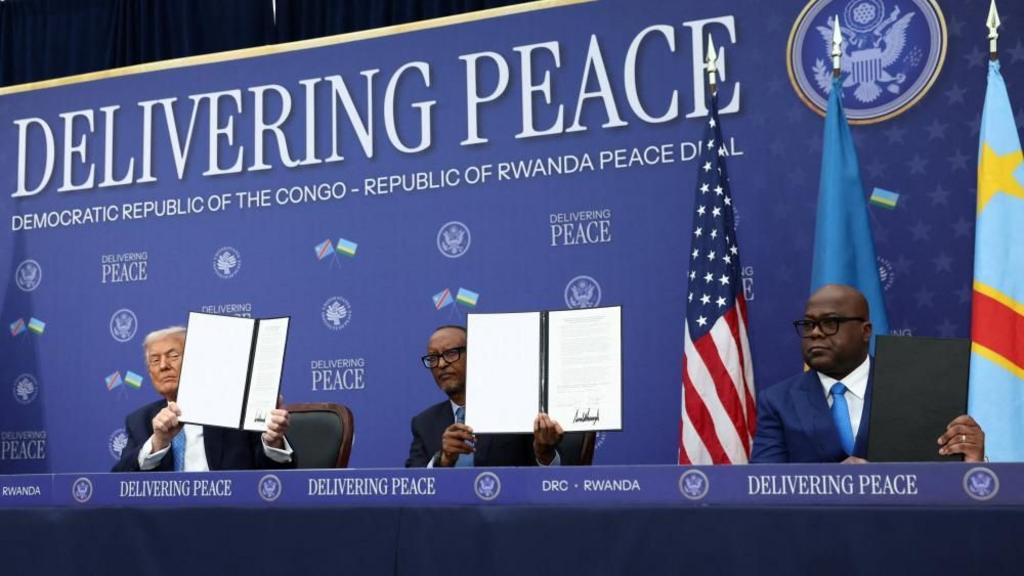
The leaders of the Democratic Republic of Congo and Rwanda signed a peace deal in Washington aimed at the long-running conflict in the eastern Congo, at a summit hosted by US President Donald Trump in Washington.
The African Union Commission (AUC) chairperson, Mahmoud Ali Youssouf, praised the peace deal, describing it as a significant milestone to create lasting peace and security in the Great Lakes region.
At the start of this year, the fighting hit its peak when M23 rebels, believed to be backed by Rwanda, rocked eastern Congo and seized two of the region’s largest cities. This caused the killing of thousands and the displacement of nearly a quarter of a million people.
Shortly before the signing, President Trump said the ceremony was a “great day” for Africa and the world.
“I have a lot of confidence in both leaders,” Trump added. “We’ll keep these commitments. I know they’re going to keep them and follow through on the agreement and create a much brighter future for the people of their countries.”
Trump also signed bilateral agreements with the Congo and Rwanda that will unlock rare earth minerals to US companies.
DR Congo’s President Felix Tshisekedi and his Rwandan counterpart, Paul Kagame, have frequently exchanged insults in recent years, each accusing the other of starting the conflict.
Trump got the two countries’ foreign ministers to sign a peace accord in June, hailing it as a “glorious triumph”.
Tshisekedi and Kagame have now endorsed it, as have a number of other African leaders who attended the signing ceremony, including those from Kenya, Angola, Burundi, and Togo, as well as the vice-president of Uganda.
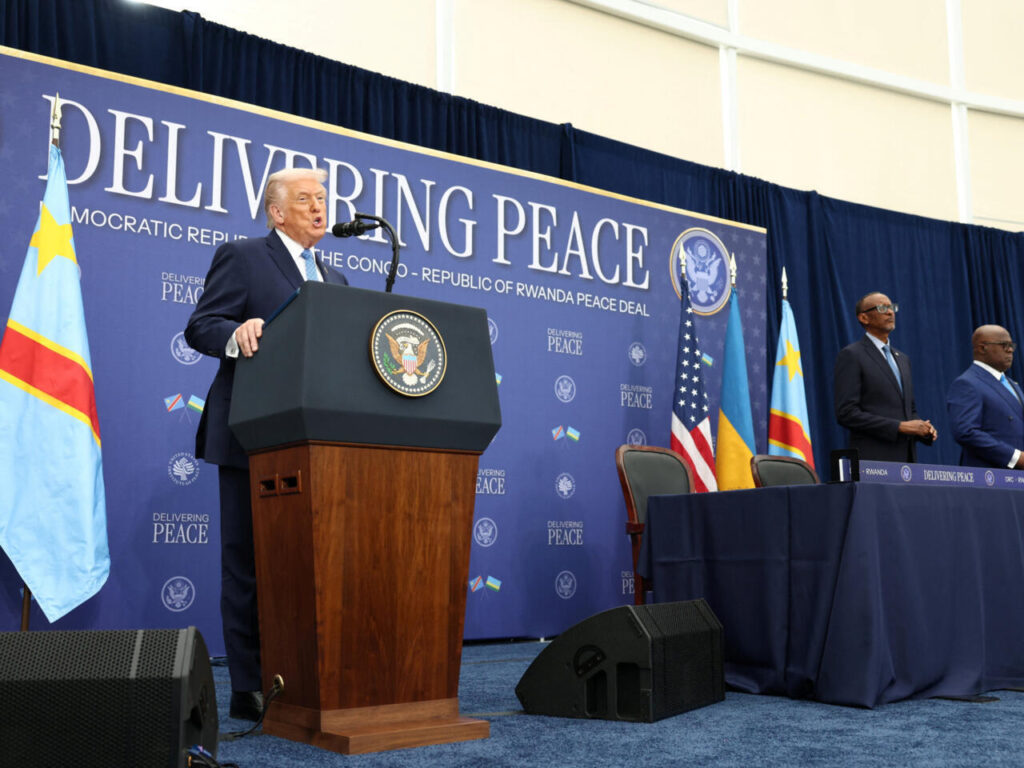
At the event, Kagame praised Trump as an “even-handed” leader who is “never taking sides”. Kagame described Trump’s approach as pragmatic and said that “as a result, we have the clearest and most viable path forward that we have ever had.”
Tshisekedi expressed “deep gratitude and clear hope,” while at the same time saying he hoped Rwanda will “respect the letter and spirit of the deal.”
The foreign ministers of Qatar and the UAE were also in attendance, as was US Secretary of State Marco Rubio.
Conflict’s root cause
The conflict can be traced to the aftermath of the 1994 genocide in Rwanda, where Hutu militias killed between 500,000 and 1 million ethnic Tutsi, as well as moderate Hutus and Twa Indigenous people. When Tutsi-led forces fought back, nearly 2 million Hutus crossed into Congo, fearing reprisals.
Rwandan authorities have accused the Hutus who fled of participating in the genocide and alleged that elements of the Congolese army protected them. They have argued that the militias formed by a small fraction of the Hutus are a threat to Rwanda’s Tutsi population.
Congo’s government has said there can’t be permanent peace if Rwanda doesn’t withdraw its forces.

One Response