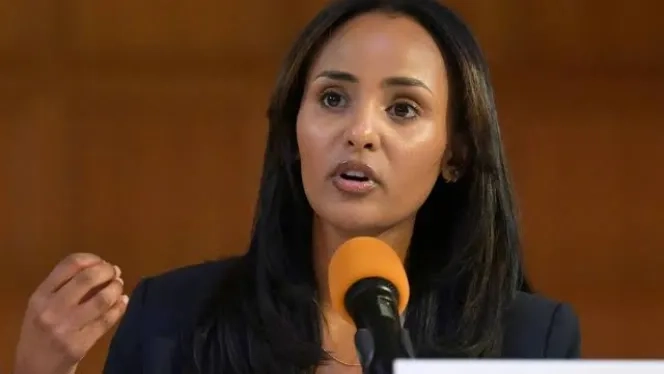
An Ethiopian-born woman, Melat Kiros, 29, became the first Gen Z woman elected to the US Congress.
She had never held elected office before defeating a 15-term incumbent in Colorado’s 1st District in the Democratic primary, before winning in a landslide in Tuesday’s election.
Kiros, like El-Sayed, campaigned on issues that have become central to young progressive voters: the cost of living, universal childcare, and Medicare for All. Endorsed by the Democratic Socialists of America, she has also called for abolishing Immigration and Customs Enforcement and ending US military aid to Israel.
Her outspoken criticism of Israel’s war in Gaza has attracted controversy. Kiros has said her criticism is directed at the Israeli state, not Jewish people. She was fired from a top New York law firm in 2023 after she refused to take down an open letter to dozens of law firms that had urged law school deans to crack down on antisemitism on campuses as students engaged in pro-Palestinian protests. Kiros condemned antisemitism but warned the law firms, including the one she worked for, against conflating “such bigotry with the geopolitical question of Israel’s legitimacy.” She said she started thinking more seriously about politics in general after being fired.
“JD [Vance], habibi (my love).”
It was an unlikely greeting to hear at a Democratic Party victory rally after the US midterm elections. Abdul El-Sayed, 42, born to Egyptian immigrant parents, playfully addressed Vice President JD Vance, who had campaigned against him but will now swear him into office in January as Michigan’s new Senator.
The US-born Democrat spent much of his campaign fending off attacks from conservative media and President Donald Trump, who accused him of supporting the Muslim Brotherhood. El-Sayed rejected the allegations.
“My name is Abdul Rahman Mohammed El-Sayed,” he said in an Egyptian Arabic accent to the cheering crowd at his victory rally. His Arabic Muslim name was a target for many of his opponents.
He is set to become the first Muslim senator. El-Sayed ran a social media-first campaign, with TikTok edits showing him speaking directly to young voters, tapping into Gen Z humor, and sporting friendship bracelets.
The former public health administrator’s campaign centered on a progressive agenda, including Medicare for All, affordable housing, and curbing corporate influence in politics. He has also been a vocal critic of US military aid to Israel.
But El-Sayed was not alone. From an Ethiopian-born Gen Z congresswoman to candidates with Nigerian heritage, several other politicians with African roots won in this year’s midterms. The elections, held halfway through a president’s four-year term, decide who represents Americans in Congress, as well as in thousands of state and local offices.
Adrian Boafo, meanwhile, a second-generation Ghanaian-American, will represent Maryland’s 5th Congressional District after succeeding veteran Congressman Steny Hoyer, who retired after a political career spanning more than four decades.
Trump has previously used derogatory language to describe some African countries, including Somalia, and personally attacked Member of Congress Ilhan Omar, who is of Somali descent.
Other Africans are also breaking through in state and local politics in the US.