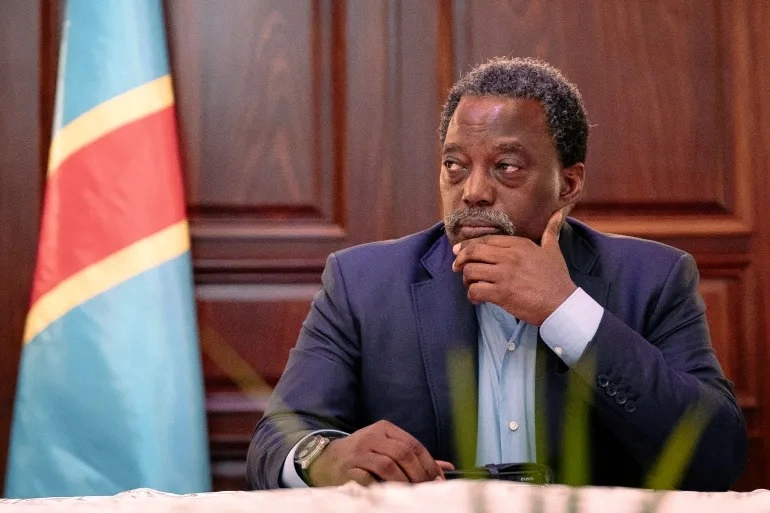
Former Democratic Republic of the Congo (DRC) President Joseph Kabila has launched a new political and military coalition, the Front for the Refoundation of the Nation (FRN), bringing together rebel groups, including the Rwanda-backed M23 movement, which controls large areas of eastern DRC.
Kabila announced the formation of the coalition at a news conference on Monday at his residence in Goma, a key city in eastern DRC that has been under M23 control since January 2025. He said he would lead the FRN alongside rebel leaders, including Corneille Nangaa, head of the Congo River Alliance (AFC), the political wing of the M23 movement.
Claude Ibalanky, an adviser to the coalition, said the FRN aims to unite resistance forces to challenge the current government, declaring that the group would pursue its objectives “by any means necessary, including the use of force”.
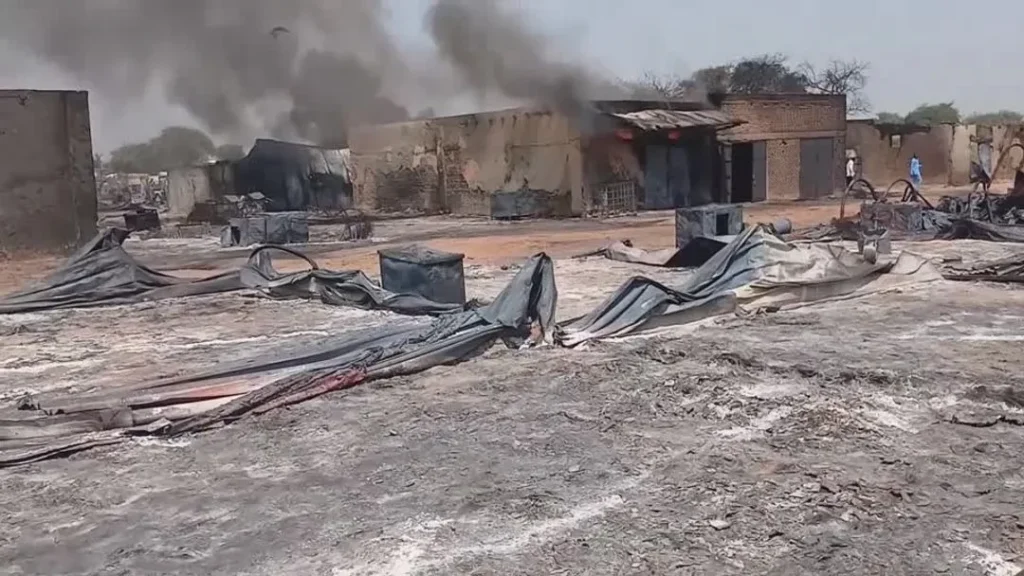
The announcement has raised concerns about a possible escalation of the conflict in eastern DRC and further setbacks to ongoing peace efforts.
According to Aljezeera, Congolese government did not respond to the announcement.
The Congolese government has struggled to regain control of the territories captured by the rebels, while efforts to negotiate an end to the conflict have repeatedly faced setbacks, with both sides accusing each other of undermining the process.
The announcement also raises questions about the future of diplomatic efforts aimed at ending the conflict.
Representatives of the Congolese government and the M23 movement were expected to hold talks in Qatar in November, but analysts warn that the creation of the new coalition could complicate negotiations and weaken prospects for a peaceful settlement.
Kabila’s decision to align himself openly with a coalition that includes M23 marks a significant development in the political and security crisis in eastern DRC, where fighting has displaced millions of people and disrupted communities for years.
Kabila governed the DRC from 2001 to 2019. He became president at the age of 29 following the assassination of his father, Laurent Kabila, who had led the country after the overthrow of Mobutu Sese Seko.
His relationship with the current administration has deteriorated sharply. In 2025, a Congolese military court sentenced him to death in absentia after convicting him on charges including treason, war crimes and crimes against humanity. The case centred on allegations that he collaborated with Rwanda and the M23 movement.
Kabila has rejected the accusations, describing the proceedings as politically motivated.
The United States also imposed sanctions on Kabila earlier in 2026 over his alleged role in financing armed groups involved in the conflict.
The DRC government, the United States and United Nations experts have accused Rwanda of providing support to M23, including military assistance. Rwanda has repeatedly denied backing the armed group.
The conflict in eastern DRC has roots in regional tensions, armed group activity and disputes over political power, security and access to the region’s mineral resources. M23 resumed its offensive in 2021 and expanded its territorial control, capturing Goma and Bukavu in early 2025.
The latest political realignment comes as Tshisekedi approaches the end of his second presidential term in 2028. His allies have also been preparing public opinion for possible changes to the constitution’s two-term limit, adding to political uncertainty as the security situation in the east continues to deteriorate.
With Kabila now leading a coalition that includes M23, concerns are growing that the conflict could enter a more dangerous phase, further complicating efforts to restore government control and achieve lasting peace in the DRC.