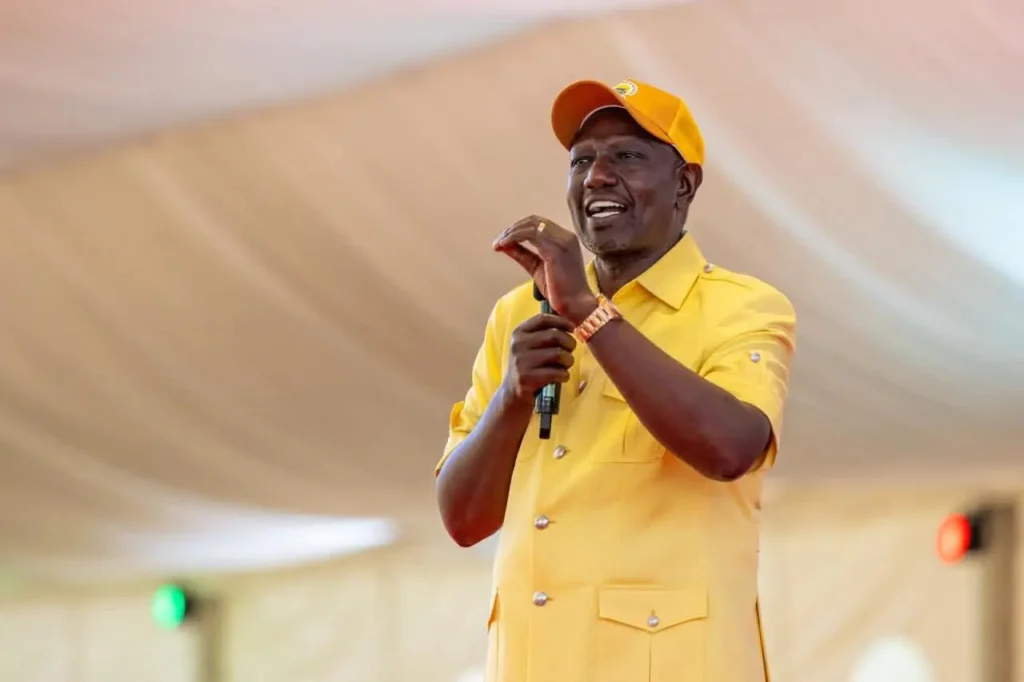
Kenyan President William Ruto has ordered a crackdown on foreign nationals operating small-scale businesses in the country, saying local traders and hawkers must be protected from competition.
According to BBC, Ruto said foreign investors remained welcome in Kenya but insisted that they should focus on creating jobs, expanding production and bringing investment rather than competing with Kenyans in small-scale businesses.
“From next week, all traders doing those small businesses should close them,” Ruto said on Wednesday while addressing representatives of micro, small and medium-sized enterprises at State House in Nairobi. The government is expected to begin the enforcement action on Monday, September 7.
Ruto specifically referred to foreigners operating as hawkers and running small shops, saying such businesses should provide opportunities for Kenyan citizens.
“It cannot be that a person comes from China or elsewhere to be a hawker or open a small shop,” he said.
The president said Kenya’s efforts to improve the business environment and attract investment were not intended to encourage foreigners to enter low-capital trading activities.
“We have made efforts to improve the economy, we have not improved investor confidence for hawkers to come to Kenya,” Ruto said.
He also said the government would accelerate proposed legislation aimed at preventing foreigners from engaging in certain categories of business.
“We have a Bill in Parliament on Trade. In that Bill, Local Content Bill, 2025, we have proposed that there should be businesses that foreigners should not do here in Kenya, by law,” Ruto said.
The Local Content Bill is currently before Parliament and seeks to increase Kenyan participation in economic activities, including through greater use of local businesses, workers and suppliers. Ruto directed National Assembly Majority Leader Kimani Ichung’wah and Trade Cabinet Secretary Lee Kinyanjui to speed up work on the legislation.
The president’s announcement has raised questions about how the planned crackdown will be implemented. The government has not yet provided a comprehensive list of the businesses that will be affected or explained how authorities will identify foreign-owned small businesses.
The move comes amid growing concerns in Kenya over competition between local traders and foreign nationals working in the informal economy.
Foreign nationals from across Africa and beyond are involved in a range of small-scale activities in Kenya, including retail, street vending, salons, barber shops, construction and the sale of clothing and household goods.
Some migrants have moved to Kenya because of conflict or economic difficulties in their home countries, while others have taken advantage of the relatively free movement of people within the East African Community.
Kenya is also home to a large refugee population. Refugees have the right to work and operate businesses under Kenyan law, provided they obtain the required documentation and permits.
The issue has increasingly become politically sensitive as Kenyan traders complain that foreigners are taking opportunities in sectors they say should benefit citizens.
The debate has also triggered concerns about possible xenophobia and discrimination against foreign nationals.
In July, a video showing a Kenyan man confronting a Burundian trader in Nairobi and accusing him of taking business opportunities from locals sparked widespread reaction. The incident prompted calls for the protection of Burundian citizens living in Kenya.
Kenya’s foreign ministry subsequently sought to reassure Burundians and other East African nationals living in the country.
Ruto’s announcement comes at a time when Kenya is facing wider pressure from small-scale traders over the cost of doing business. In late August, police in Nairobi used tear gas to disperse traders protesting against an increase in the customs benchmark for consolidated imports. Hundreds of businesses in central Nairobi reportedly closed during the demonstrations.
The president’s crackdown is also likely to attract attention because Kenya is one of East Africa’s major economic and commercial hubs and has traditionally promoted itself as a destination for regional and international investment.