
Ethiopia and Kenya have long vied for influence and leadership in the Horn of Africa. Both countries have sought, explicitly and implicitly, to strengthen their regional standing through diplomacy, strategic partnerships, the hosting of international organizations and conferences, and mediation efforts in regional conflicts.
The competition between the two countries is largely based on soft power rather than direct confrontation, as they have generally maintained cordial relations for many years. The two countries also cooperate on security matters and have military agreements aimed at combating insurgent groups operating along their shared border.
Historically, Ethiopia has enjoyed an advantage in regional influence. This is partly due to its status as the host of the African Union headquarters and its role as one of the founding members of the United Nations in 1945. Successive Ethiopian governments have capitalized on these factors to enhance the country’s image and strengthen its regional and international influence.

In recent years, however, Kenya has appeared increasingly determined to expand its regional profile. One notable example is the recent expansion of the United Nations Office in Nairobi, a project valued at approximately $400 million. The launch ceremony was attended by UN Secretary-General António Guterres and Kenyan President William Ruto.
Kenya’s leadership has framed such developments as evidence of the country’s growing international influence. The country has also hosted high-profile international conferences and strengthened its partnerships with Western countries. These diplomatic achievements have reinforced Kenya’s importance in the region and elevated its international visibility.
Meanwhile, Ethiopia has pursued a more diversified foreign policy, including joining BRICS while maintaining relations with Western partners. Kenya, by contrast, has continued to deepen its ties with the United States and its Western allies.

It is clear that both kcountries aspire to be leading powers in the Horn of Africa. However, the question of which country currently leads this competition remains open to debate.
While diplomatic influence is often measured through international visibility and political alliances, economic indicators such as national budgets, debt burdens, and social development outcomes can provide a more objective measure of a country’s underlying strength.
National Budgets
The difference between the national budgets of the two countries is significant. Kenya’s national budget for the 2026/27 fiscal year stands at approximately $37 billion, nearly three times larger than Ethiopia’s budget of about $14.5 billion.
These figures suggest that Kenya’s government spending capacity is substantially greater than Ethiopia’s. The gap is also reflected in per-capita income. While Kenya’s GDP per capita is estimated at around $1,500, Ethiopia’s is roughly $500. Despite its smaller economy, Ethiopia is projected to record stronger economic growth. According to recent projections, Ethiopia’s economy is expected to grow by about 10.2 percent, compared with around 4 to 5 percent for Kenya.
Debt Burden
Debt is an important macroeconomic factor influencing a country’s economic performance. Although Kenya has a considerably larger budget than Ethiopia, it also carries a heavier debt burden. As of March 2026, Kenya’s public debt stood at 99 billion USD, equivalent to nearly 70 percent of GDP. As a result, a substantial portion of Kenya’s national budget is allocated to debt servicing and repayment obligations. This means that comparisons based solely on budget size may not fully reflect the resources available for development spending and investment. While Ethiopia is not free from debt-related challenges, its debt burden remains lower than Kenya’s. IMF data show that Ethiopia’s public debt stood at roughly 50 percent of GDP by mid-2025, significantly below Kenya’s level.
For this reason, economic performance should also be assessed in terms of how much public spending is directed toward productive investment and development priorities.
Similarly, growth projections should be considered alongside the overall size and structure of each economy.
Overall, Kenya’s debt burden remains significantly higher than Ethiopia’s, placing greater pressure on public finances.
Hunger Index
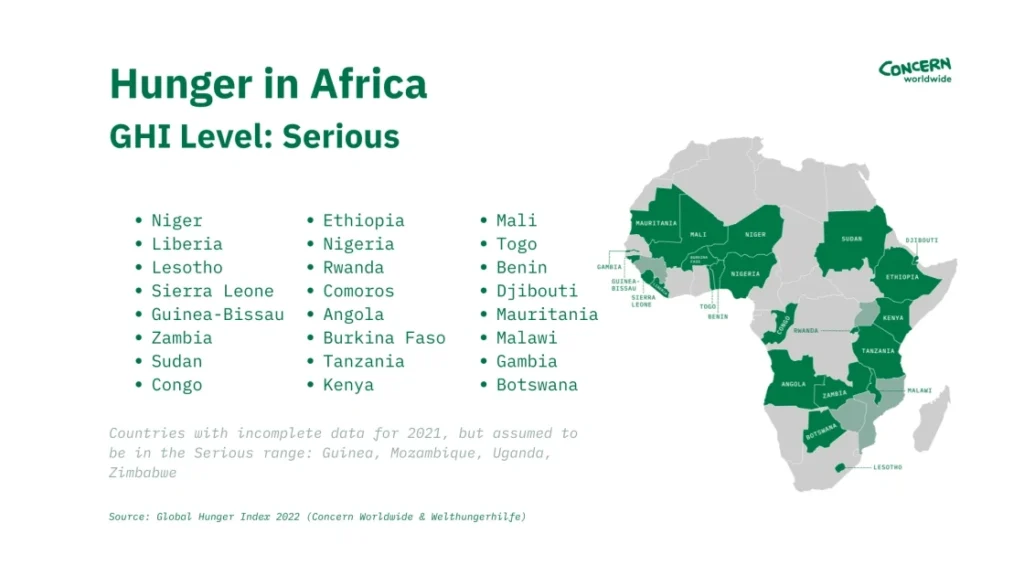
The Global Hunger Index (GHI) evaluates countries based on four indicators: undernourishment, child stunting, child wasting, and child mortality.
According to the index, both Ethiopia and Kenya continue to face serious food-security challenges. However, Kenya records a slightly higher hunger score than Ethiopia. Kenya’s GHI score stands at approximately 25, compared with Ethiopia’s 24.4.
The prevalence of undernourishment is estimated at around 36.8 percent in Kenya, compared with 19.7 percent in Ethiopia. These figures suggest that hunger remains a significant challenge in both countries despite differences in economic performance and income levels.
In conclusion, the comparison between the two countries presents a mixed picture. Kenya has a larger economy, higher per-capita income, and a bigger national budget, but it also carries a heavier debt burden. Ethiopia, despite having a smaller economy, has recorded faster growth and maintains a relatively lower debt burden. The GHI places Kenya slightly behind Ethiopia. Ultimately, budget size alone does not necessarily determine the strength or performance of a national economy.
Read the Amharic Version here.