French President Emmanuel Macron and his Rwandan counterpart Paul Kagame jointly inaugurated a permanent memorial in the heart of Paris to honor the victims of the 1994 genocide against the Tutsi.
Unveiled on Tuesday on the banks of the Seine River, the monument stands as an institutional reckoning for France’s past geopolitical failures. Speaking at the ceremony, President Macron stated that the memorial permanently inscribes the 1994 tragedy “at the heart of our capital and our history,” calling it “the culmination of a long and painstaking quest for the truth”.
‘L’Archive’ Remembrance
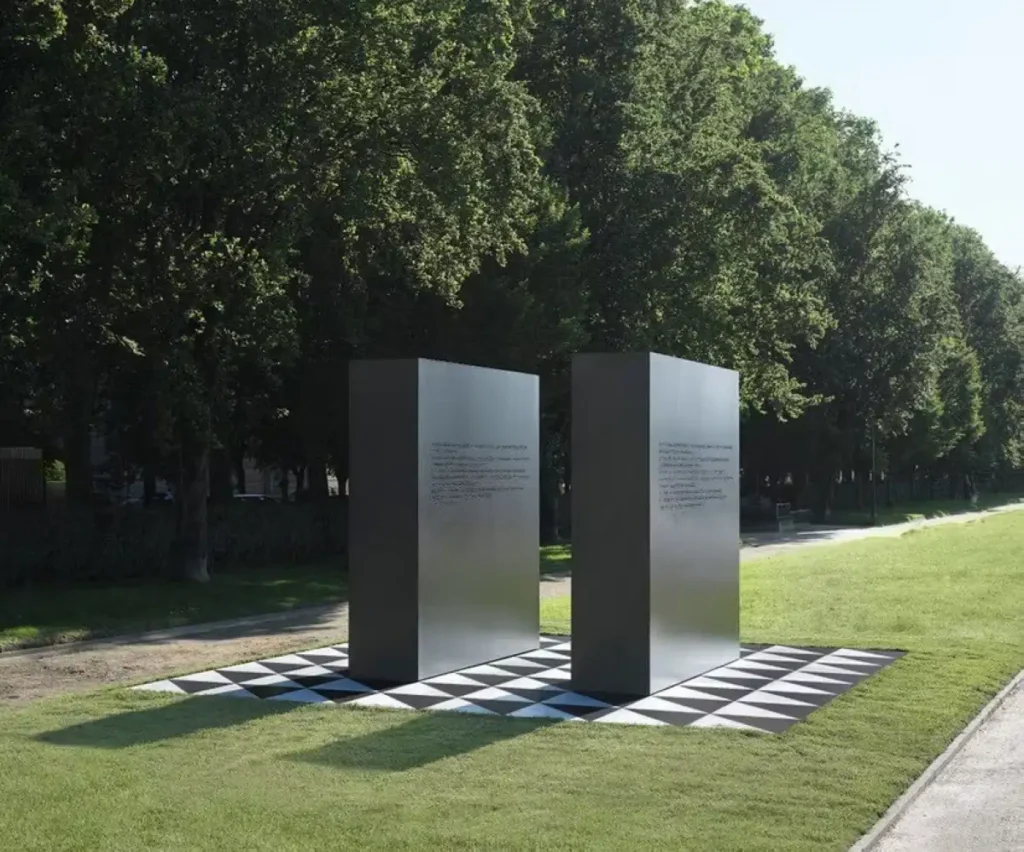
Dubbed “L’Archive” (The Archive), the minimalist monument is located on the prominent Habib-Bourguiba Esplanade overlooking the Seine, situated in a high-traffic zone near the Eiffel Tower to ensure global visibility.
Designed by renowned Portuguese artist Grada Kilomba, the design moves away from traditional figurative statues in favor of stark abstraction to convey the immense scale of the slaughter:
- The Monoliths: The memorial features two black brass steles engraved with a tribute to the estimated 800,000 men, women, and children, mostly ethnic Tutsis and moderate Hutus, massacred over a 100-day period between April and July 1994.
- Rwandan Soil: The brass structures are mounted on a volcanic lava-stone platform explicitly inspired by traditional Rwandan Imigongo designs. Kilomba conceptualized the platform to act as a physical fragment of Rwandan soil embedded directly into the French capital.
The creation of the monument marks the realization of decades of intensive lobbying by genocide survivors’ organizations, researchers, and civil society groups, spearheaded primarily by Ibuka France.
At the Paris unveiling, Macron noted that the monument is an undeniable victory for historical transparency, declaring:
“An unprecedented reconciliation has emerged between Rwanda and France. This monument, while it is an achievement, is not an end. It is a milestone on a path we have opened.”
President Paul Kagame, accompanied by First Lady Jeannette Kagame, lauded the French state for its willingness to confront its historical shortcomings. He noted that L’Archive represents far more than a physical structure—it preserves historical truth for future generations.
“France was not alone in falling short, far from it,” Kagame told the crowd. “Many other countries did so as well, but none has gone as far as France in setting the record straight and accepting its part in the tragedy.”
Kagame added that confronting such institutional failures requires real courage because it invariably generates fierce pushback from factions within political establishments who still have a case to answer. With the genocide now fully integrated into France’s public history, both nations view the monument as a definitive foundation for future diplomatic and economic partnerships.