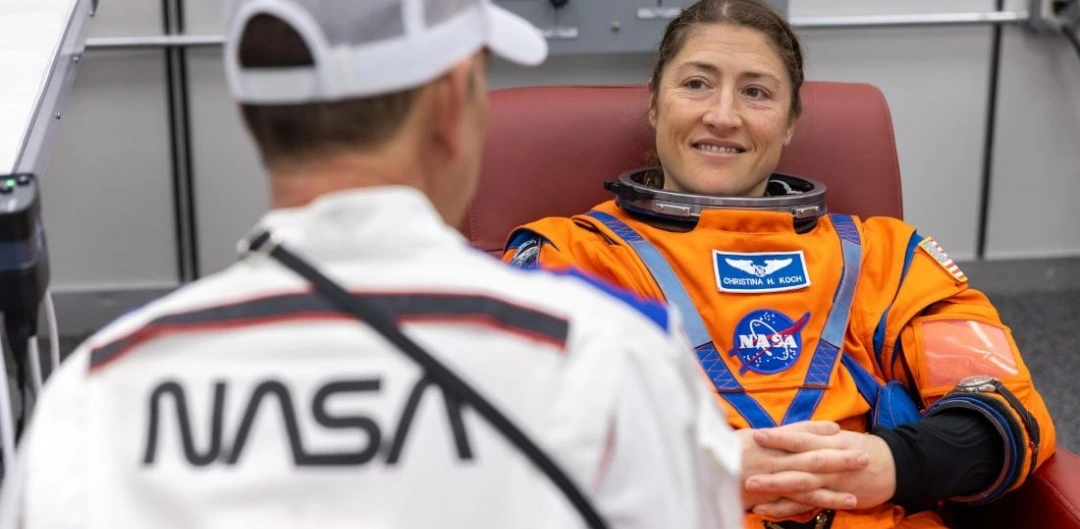
For decades, the moon was a “man’s world.” Between 1969 and 1972, twelve humans walked on the lunar surface; all twelve were men. But as the Artemis II mission cruises toward the lunar far side this April 2026, the silhouette of the explorer has changed. Leading this charge is Christina Koch, a woman whose career has been defined by outlasting the status quo.

Who is Christina Koch?
Christina Koch isn’t just a passenger; she is an engineer of human limits. While the world knows her as the woman who spent 328 days in orbit, the longest single spaceflight by a woman, her journey began in the most grounded of places: a family farm in Michigan.
Koch’s academic pedigree is a “Triple Threat” from North Carolina State University, holding degrees in Electrical Engineering and Physics. But it was her time in Antarctica that truly forged her for the moon. Serving as a firefighter and search-and-rescue lead in the frozen isolation of the South Pole, Koch mastered the “extreme environment” psychology required for deep-space travel.
Today, she isn’t just representing NASA; she is representing a shift in the scientific meritocracy where technical brilliance, not gender, dictates who sits in the commander’s seat.

The “Liquid Fire” Legacy: The Ghost of Mary Sherman Morgan
To understand Koch’s success, we must look back at a name history almost forgot: Mary Sherman Morgan. In the 1950s, the American space program was failing. Rockets were exploding on the pad because their fuel lacked the “punch” to escape Earth’s gravity.
Enter Mary Sherman Morgan, the only woman among 900 engineers at North American Aviation. She didn’t just study fuel; she invented it. Her creation, a potent chemical cocktail called Hydyne, provided the extra thrust needed to launch Explorer 1, America’s first satellite.
For years, Mary’s contribution was classified or ignored. Today, the “liquid fire” she invented lives on in the spirit of the Artemis scientists. The women calculating the trajectories for Artemis II are the direct intellectual descendants of a woman who was once told she didn’t belong in a lab.

Why This Matters for the “Global South”
At Afro Insight, we ask: What does a lunar orbit mean for an aspiring scientist in Addis Ababa, Nairobi, or Dakar? The answer lies in the democratization of the stars. When Christina Koch looks out the window of the Orion capsule, she sees a world where the barriers to entry are finally crumbling. The technologies being perfected by these female scientists, water purification, compact solar energy, and tele-medicine, are the same technologies that will eventually solve terrestrial challenges in Africa.
The Artemis mission proves that the “Space Race” is no longer just about flags and footprints. It is about a diverse human collective finally using 100% of its brainpower, men and women alike, to reach for the next frontier.
Read the Amharic story here.